Welcome back for another exciting addition of Fantastic Five Friday! I say exciting because this week I'm dealing with the always intriguing topic of literary villains. Oooo! Ahhh! Villains can be horrible indeed and love 'em or hate 'em they certainly do make for a more exciting read.
So let's talk about my Fantastic Five Literary Villains!
Humbert Humbert
in Lolita by Vladimir Nabokov
I've seen this book listed in other lists of famously intriguing and awesome villains in literature, but to my surprise they have the character of Quilty listed as the awful villain. Now, I'm not going to say that Quilty was a good guy, he wasn't. He was just as despicable as Humbert. But one of the whole points of the novel is that Humbert is trying to convince the reader and himself that he's a good guy, that he always loved Lolita. Well, he's the one that took her from her home. He's the one that prayed upon her when she was just a child. He's a pedophile. Quilty was horrible as well but it's as though he felt that by the end if he got rid of Quilty he had somehow absolved himself of all the horrible things HE had done. Sorry, no dice. You sir, Humbert, are the villain of this tale because you don't even realize that you're the scum.
Mrs. Danvers
in Rebecca by Daphne du Maurier
If you haven't read this book then I have one thing to say to you: read it. Now. It's just fantastic. And Mrs. Danvers is one of the main reasons. She is a remarkable villain indeed. The new Mrs. de Winter comes to live with her husband at Manderlay and the head of the staff, Mrs. Danvers, cannot let go of her old employer, Rebecca. She constantly haunts Mrs. de Winter with images of Rebecca and her perfection, how nobody could ever replace her, how nobody wants a new Mrs. de Winter, etc. At one point she basically almost goads her into jumping out of a window and KILLING HERSELF! Now that's a villain!
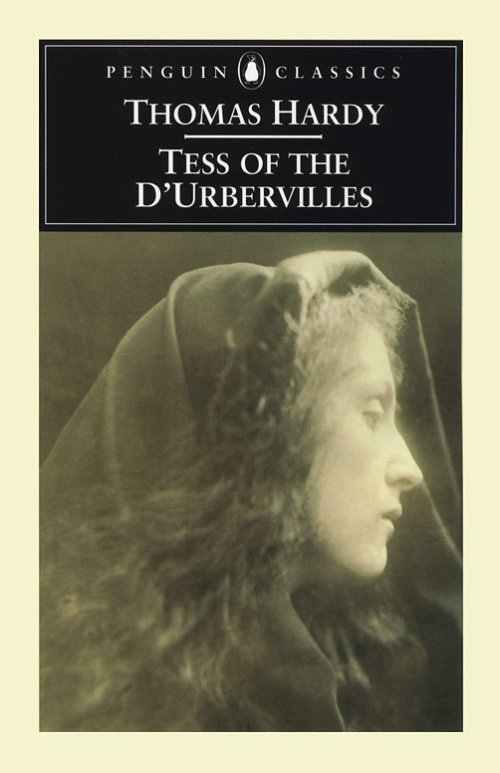
Alec d'Urberville
in Tess of the d'Urbervilles by Thomas Hardy
I just finished this book the other week and posted my review yesterday, so if you haven't read that you can check it out HERE. But this character is a real S.O.B. I explained the horrible stuff he does in my review so I don't want to rehash it here, but what makes him a great villain in my opinion is that he is so charming. Smarmy is another word for it. He seems to charm almost every woman he comes across in the novel. And after he happens across Tess again much later in her life, after the dreadful incident in The Chase, one can't help but feel drawn to him. Therein lies his power. The jerk!
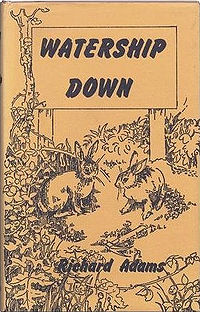
General Woundwort
in Watership Down by Richard Adams
I don't know how many of you have read this book but it is a lovely tale of survival told by...rabbits. It's a classic and one that I just read a little less than a year ago. And I was so glad I did. They're journeying to find a new warren and on their way the find the warren known as Efrafa led by the horrible General Woundwort. He's a tyrannical beast of a rabbit and they basically battle like...well the animals that they are. I've never been so afraid of a rabbit in all my life.
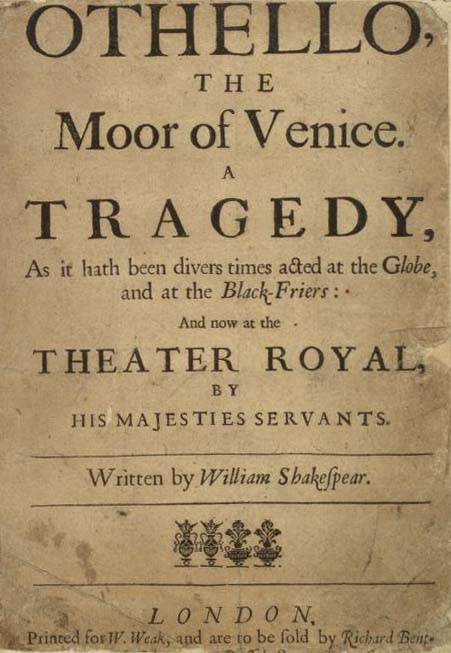
Iago
in Othello by William Shakespeare
This play is all about the evilness that is Iago in my opinion. I mean, the character of Iago whispering and spreading hateful lies in another person's ear has been copied over so many times it's ridiculous. That's because the character is just so wonderful. Nobody writes them like Shakespeare. Iago plays ALL sides and does it to such a masterous level it's astounding. And he thinks nothing of the consequences of his actions as long as the end result is that he gets more power. He gets people KILLED in the process and doesn't bat an eye. Best villain ever.
So what about the rest of you? Who are your favorite villains in literature?
Showing posts with label Othello. Show all posts
Friday, March 18, 2011
Wednesday, February 23, 2011
Review for You - Othello
Othello by William Shakespeare
4 stars
4 stars
Everyone knows the tale of Othello, or almost everyone at least. A Moor (otherwise known as black guy), Othello, falls in love and marries a white woman, Desdemona, and through the evilness of his servant, Iago, is tricked into thinking her untrue and unloyal and kills her in a fit of rage. Sorry for the spoiler there but, like I said, who doesn’t know this story? I knew it before I read it. The real point of reading it is in the beauty of the language and to see it all unfold.
From the moment the play starts Iago feels slighted for basically no reason at all and sets it in his mind to ruin his master, Othello. To do this he enlists the help of his friend, Roderigo, who wants the lovely Desdemona for his own. They come up with a wonderful plan to make Othello think that Desdemona is sleeping around with Cassio, Othello’s lieutenant. However Iago doesn’t really tell Roderigo the whole plan because well, it won’t work if Roderigo LIVES at the end of it. Of course, Othello thinks of Iago as nothing but a kind and loyal servant and calls him “honest” over and over again. So naturally when he calls Desdemona unfaithful Othello believes him almost immediately. The wheels having been so easily set in motion, Othello goes into her room at night and utters the famous line: “Have you prayed tonight, Desdemona?” And thusly strangles her.
Now this was a fantastic Shakespeare play. It had all the elements to make it great, even though I knew the ending. Murder, deception, jealousy, intrigue. However a feminist work it certainly was not. I could not count the number of times the men threw about the words “whore” and “strumpet” simply because the women said something they did not like or because Othello wrongly thought Desdemona untrue. And the implication that it is alright to KILL your WIFE just because she cheats on you is entirely ridiculous as it is. Only when Othello finds out that he was wrong and Iago tricked him does he feel any sort of remorse for his actions.
So, read it for the language and the awesomeness that is Shakespeare. But don’t expect to feel all warm and tingly inside afterwards. And Iago is a very good evil villain indeed.
From the moment the play starts Iago feels slighted for basically no reason at all and sets it in his mind to ruin his master, Othello. To do this he enlists the help of his friend, Roderigo, who wants the lovely Desdemona for his own. They come up with a wonderful plan to make Othello think that Desdemona is sleeping around with Cassio, Othello’s lieutenant. However Iago doesn’t really tell Roderigo the whole plan because well, it won’t work if Roderigo LIVES at the end of it. Of course, Othello thinks of Iago as nothing but a kind and loyal servant and calls him “honest” over and over again. So naturally when he calls Desdemona unfaithful Othello believes him almost immediately. The wheels having been so easily set in motion, Othello goes into her room at night and utters the famous line: “Have you prayed tonight, Desdemona?” And thusly strangles her.
Now this was a fantastic Shakespeare play. It had all the elements to make it great, even though I knew the ending. Murder, deception, jealousy, intrigue. However a feminist work it certainly was not. I could not count the number of times the men threw about the words “whore” and “strumpet” simply because the women said something they did not like or because Othello wrongly thought Desdemona untrue. And the implication that it is alright to KILL your WIFE just because she cheats on you is entirely ridiculous as it is. Only when Othello finds out that he was wrong and Iago tricked him does he feel any sort of remorse for his actions.
So, read it for the language and the awesomeness that is Shakespeare. But don’t expect to feel all warm and tingly inside afterwards. And Iago is a very good evil villain indeed.
Tuesday, February 15, 2011
Bechdel Test Tuesday!
Welcome back for another exciting addition of Bechdel Test Tuesday! Now you have to shout that last part like a game show host, otherwise it’s simply not as fun. Are you all as pumped as I am (of course you are!)? First time looking in on my awesome weekly meme? Well then here’s a quick overview of what the Bechdel Test is all about.Well, last week the book Rebecca passed the challenge with flying colors! Will it be quite so simple for the book I pick this time around? It’s time to find out. Let's step up to the plate with…Othello!
Othello by William Shakespeare
1. Does it have at least 2 women in it?
It does. Though not a lot. Only 3 women total.
2. Do they talk to each other?
Only 2 of them talk to each other: Desdemona and her maid, Emilia.
3. About something besides a man?
Nope nope nope nope nope! Unfortunately Emilia and Desdemona do have lengthy conversations but it is ENTIRELY about Othello! What's he thinking? Why is he acting like this? Marcia, Marcia, Marcia!
Sorry Shakespeare. I’m going to have to fail you. But I had a feeling it was coming with what this play was about and all…better luck next time!
Tune in next week for another awesome installment of Bechdel Test Tuesday! And if you have any suggestions for future titles to be featured, please leave them in the comments :)
Monday, February 14, 2011
Happy Valentine's Day!
Happy Valentine’s Day everyone! I hope everyone has had as lovely a day as possible, be it with friends or significant others…or pets! My kitty is my Valentine (aw shucks!).
And how fitting was it that on this Hallmark Holiday I finished up the very un-romantic Shakespearean play, Othello, where the main character is driven insane with jealousy planted in his head by the evil Iago and therefore decides to murder the innocent Desdemona. Not a very feminist play, eh? Especially seeing as how Othello thinks he did absolutely nothing wrong by committing that horrid act of domestic violence UNTIL he finds out that his wife was in fact true and faithful the whole time. Because otherwise it’s perfectly acceptable to go around killing your wife! Strumpets all of them! But my full review is to come later. I promise.
But, since I don’t want to seem totally unromantic, I will leave you with a beautiful Shakespearean sonnet to lighten the mood. I’m sure many of you know it already. It’s one of his most famous:
Shall I compare thee to a summer's day?
Thou art more lovely and more temperate:
Rough winds do shake the darling buds of May,
And summer's lease hath all too short a date:
Sometime too hot the eye of heaven shines,
And often is his gold complexion dimm'd;
And every fair from fair sometime declines,
By chance, or nature's changing course, untrimm'd;
But thy eternal summer shall not fade,
Nor lose possession of that fair thou owest;
Nor shall Death brag thou wander'st in his shade,
When in eternal lines to time thou growest;
So long as men can breathe, or eyes can see,
So long lives this, and this gives life to thee.
Thou art more lovely and more temperate:
Rough winds do shake the darling buds of May,
And summer's lease hath all too short a date:
Sometime too hot the eye of heaven shines,
And often is his gold complexion dimm'd;
And every fair from fair sometime declines,
By chance, or nature's changing course, untrimm'd;
But thy eternal summer shall not fade,
Nor lose possession of that fair thou owest;
Nor shall Death brag thou wander'st in his shade,
When in eternal lines to time thou growest;
So long as men can breathe, or eyes can see,
So long lives this, and this gives life to thee.
-William Shakespeare
Subscribe to:
Posts (Atom)